
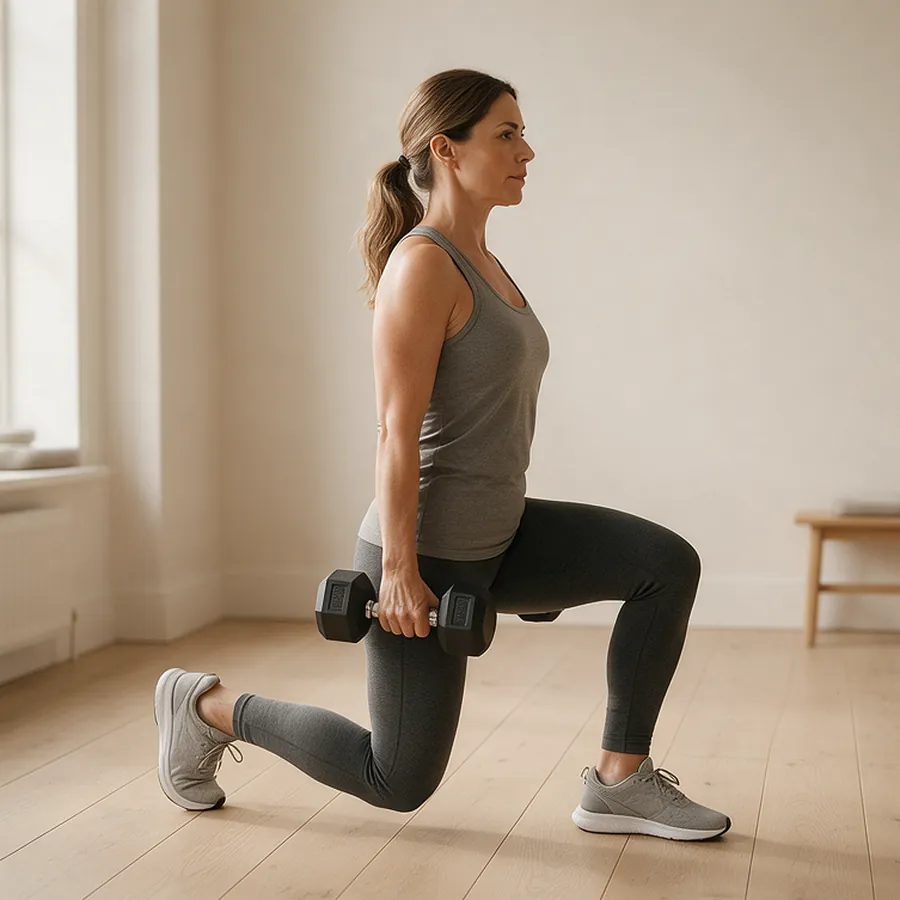
The legs and hips are two thirds of the body’s muscle and the part that decides whether the stairs, the shopping and the next decade of walking are easy. This session loads them properly in ten minutes: a lunge, a hinge, a squat and a bridge, with dumbbells heavy enough to matter. It assumes you have done the full-body session for a few weeks and know the goblet squat and the Romanian deadlift already.
The session
| Minute | Move | Reps | Notes |
|---|---|---|---|
| 0:00 to 1:30 | Warm-up: 10 bodyweight squats, 8 bodyweight step-back lunges each side, 10 glute bridges | ||
| 1:30 to 5:15 | Round one: step-back lunge, Romanian deadlift, goblet squat, single-leg glute bridge | 8 each side, 10, 10, 8 each side | Straight through, rest at the end |
| 5:15 to 6:00 | Rest, water | The one real rest in the session | |
| 6:00 to 9:30 | Round two: the same four moves | 8 each side, 8, 8, 8 each side | One notch heavier on the deadlift and squat if round one was clean |
| 9:30 to 10:00 | Finish: walk, hip flexor stretch each side |
Weights. Heavier than the full-body session, because the legs can take it: for most women who have trained a few weeks, 6 to 8 kg per hand for the lunge, 10 to 14 kg for the deadlift and squat; for most men, 10 to 12 kg and 16 to 20 kg. The last two reps should be hard and the form should not change.
The moves
1. Step-back lunge
A dumbbell in each hand at the sides, feet hip-width. Step one foot back a long stride, lower until the rear knee is just above the floor and the front shin is roughly vertical, torso upright. Push through the front heel to return. All reps one side, then the other.
The first fault: a short step that drives the front knee far past the toes and tips the torso forward. Step longer, and keep the weight in the front heel.
2. Romanian deadlift
Dumbbells in front of the thighs, knees soft and staying soft. Push the hips back, chest over the dumbbells, back flat, until the hamstrings load, usually mid-shin. Drive the hips forward to stand. Two seconds down, one up.
The first fault: turning it into a squat by bending the knees. The knees stay put; the hips travel back.
3. Goblet squat
One heavier dumbbell held vertically at the chest. Sit down between the heels to parallel or wherever the heels stay down, chest up, knees out over the toes. Stand.
The first fault: the torso folding forward as the weight goes up. Keep the dumbbell against the sternum and the elbows down; if the chest drops, the weight is too much for today.
4. Single-leg glute bridge
On the back, one foot flat, the other leg held straight in the air or the knee hugged to the chest. Push through the planted heel to lift the hips until the body is a line from knee to shoulder, pause, lower. All reps one side, then the other.
The first fault: the pelvis tilting toward the unsupported side. Lower the hips a little and squeeze the glute of the working leg harder; level hips matter more than height.
Progressing
Add weight to the deadlift and squat when two rounds are clean for two sessions; add reps to the lunge and bridge before weight. After six weeks, replace the goblet squat with the step-back lunge holding one dumbbell at the chest (the goblet lunge) one session in three, and try the deadlift on one leg with a light dumbbell as the warm-up. Two lower-body sessions a week with a day between is plenty; the full-body session covers the other patterns.
Two or three resistance sessions a week was the frequency in the trials the Westcott review covered, where ten weeks of resistance training added about 1.4 kg of lean weight and reduced fat weight by about 1.8 kg in adults, with bone density gains in longer programs; those sessions were longer than ten minutes. This one keeps the legs strong in a busy week and progresses properly; it does not promise a body shape.
Why the legs get their own session
The muscles of the hips and thighs are the largest in the body and the ones that respond most to load; they are also the ones that fade first with age and inactivity, which is why getting up from a chair becomes hard long before anything else does. The resistance training review on this page found the body-composition changes and bone density gains in programs that loaded the legs, and the walking, stairs and carrying that make up a day run through them. A single full-body session a week touches the legs twice; this session doubles that with enough weight to matter.
Single-leg work, and why it is in here
Two of the four moves load one leg at a time. The lunge and the single-leg bridge find the side that is weaker, which almost everyone has, and work it without the strong side covering for it. They also train balance and the small muscles around the hip that keep the knee tracking straight, which is the most common reason a knee complains on stairs. Start with the weaker side, so it gets the fresher reps, and match the strong side to it rather than the other way round.
A week with this session in it
| Day | Session |
|---|---|
| Monday | Full-body dumbbell |
| Tuesday | Walk, or the stretch routine |
| Wednesday | This session |
| Thursday | Walk |
| Friday | Full-body dumbbell or the kettlebell session |
| Weekend | One long walk, one rest day |
Three strength days with a day between each, which is the frequency in the trials the Westcott review covered, and the legs loaded on all three.
What the research says
- Westcott, Current Sports Medicine Reports, 2012, narrative review of resistance training in adults including middle-aged and older adults, 2 to 3 sessions a week over 10 weeks and longer: lean weight up about 1.4 kg, resting metabolic rate up about 7 percent, fat weight down about 1.8 kg over ten weeks, with bone density improvements in longer programs. The contrary finding: a mixed review, with longer sessions than ten minutes and effects that varied by age, program and starting fitness. doi.org/10.1249/JSR.0b013e31825dabb8
- Bull and colleagues, British Journal of Sports Medicine, 2020, the WHO 2020 physical activity guidelines for adults: muscle-strengthening activity involving all major muscle groups on 2 or more days a week, and the removal of the 10-minute minimum bout. The contrary finding: a guideline, not a trial, and no strength session length is specified. doi.org/10.1136/bjsports-2020-102955
- Stamatakis and colleagues, Nature Medicine, 2022, prospective cohort of 25,241 UK Biobank adults, mean age 62, no leisure-time exercise, median 6.9 years: 3 to 4 daily bouts of about one minute of vigorous everyday activity were associated with 38 to 40 percent lower all-cause mortality. The contrary finding: observational, everyday activity rather than training. doi.org/10.1038/s41591-022-02100-x
Questions people ask
My balance goes in the lunge. Shorten the step a little and put a hand on a wall for the first week; balance arrives faster than strength.
Knees in the squat? Keep them tracking over the toes and squat only as deep as is comfortable. Pain that persists after the session belongs with a physiotherapist.
Can I do this and the full-body session in the same week? Yes: full body on Monday and Friday, lower body on Wednesday, or any three days with a gap between.
What about calves? Add 15 slow calf raises off a step at the end if you want them; they fit in the finish minute.