
A chair does four things to a body over a day: it shortens the hip flexors, tightens the hamstrings, closes the chest and rounds the upper back. Six stretches undo most of it in ten minutes, and the meta-analysis evidence says the total time per muscle each week matters more than the method, so a short routine done most days beats a long one done on Sunday.
Stretch to a comfortable pull and breathe there; pain is the signal to back off. Anything sharp, or anything that stays sore, belongs with a physiotherapist.
The routine
| Minute | Stretch | Hold | Notes |
|---|---|---|---|
| 0:00 to 1:00 | Warm-up: arm circles, 10 marching steps, 5 easy squats | Cold muscles stretch badly | |
| 1:00 to 2:30 | Kneeling hip flexor stretch | 40 seconds each side | |
| 2:30 to 4:00 | Standing hamstring stretch | 40 seconds each side | Heel on a step or low stool |
| 4:00 to 5:30 | Figure-four glute stretch, seated or lying | 40 seconds each side | |
| 5:30 to 7:00 | Chest and shoulder opener | 45 seconds each side | Forearm on a door frame |
| 7:00 to 8:30 | Cat-cow | 8 slow cycles | Breathe out as the back rounds |
| 8:30 to 10:00 | Upper back opener over a chair, then stand and roll the shoulders | 60 seconds |
The stretches
1. Kneeling hip flexor stretch
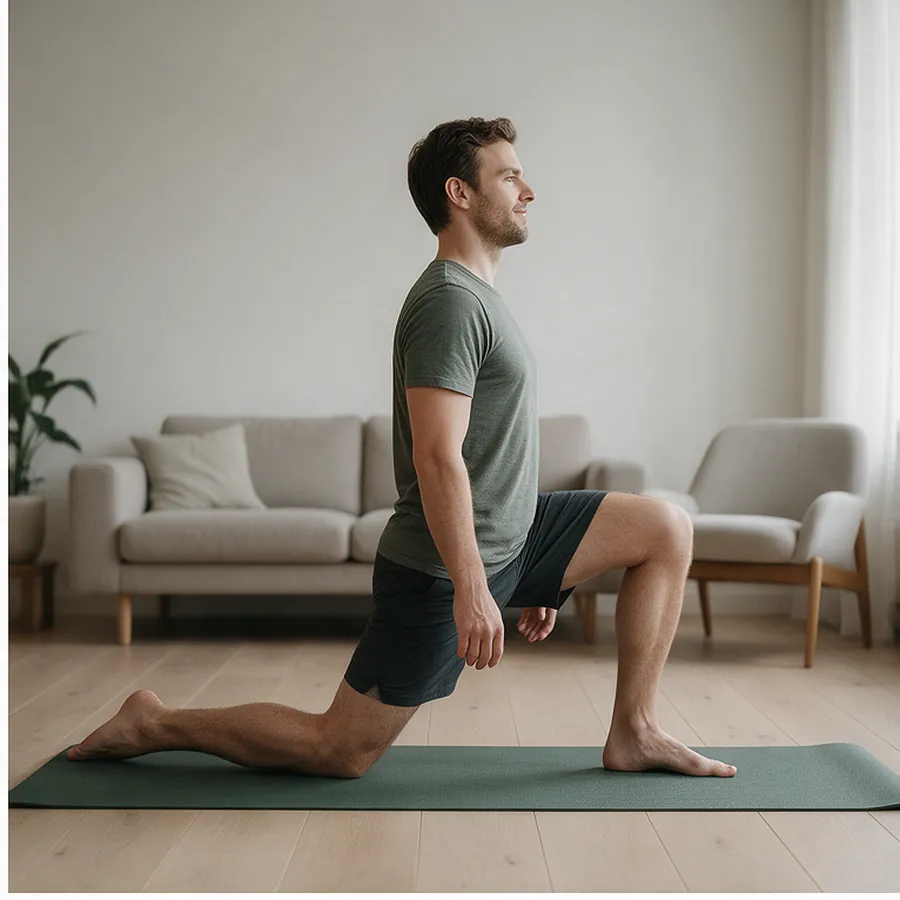
Kneel on one knee on a mat or cushion, the other foot flat in front, both knees at about ninety degrees. Tuck the tailbone under, squeeze the glute of the kneeling side, and shift the hips forward a few centimetres until you feel the front of the kneeling hip. Torso upright, not leaning forward. Raise the same-side arm overhead for more.
The first fault: arching the lower back and leaning forward, which feels like a stretch and is not one. Tuck the pelvis first; the stretch is small and deep.
2. Standing hamstring stretch
Place one heel on a step or low stool, leg straight but knee not locked, standing leg soft. Keep the back flat and hinge gently forward from the hips until the back of the raised thigh pulls. Hands on the hips, chest open.
The first fault: rounding the back to reach the toes. The hinge is at the hip; a flat back with a small lean is more stretch than a rounded back with a big one.
3. Figure-four glute stretch
Sit on the edge of a chair, or lie on the back. Cross one ankle over the opposite knee. Seated: sit tall and hinge forward from the hips. Lying: hold the back of the supporting thigh and draw it toward you. The pull is in the outside of the hip of the crossed leg.
The first fault: pushing the crossed knee down with the hand. Let it hang; the stretch comes from the hinge or the pull, not from pressure on the knee.
4. Chest and shoulder opener
Stand in a doorway with one forearm on the frame, elbow at shoulder height. Step through with the same-side foot and turn the body gently away from the arm until the chest and the front of the shoulder open. Breathe.
The first fault: shrugging the shoulder up to the ear. Pull the shoulder blade down and back first, then turn.
5. Cat-cow
On hands and knees, wrists under shoulders, knees under hips. Breathe in and let the belly drop, chest forward, eyes up, a gentle arch. Breathe out and round the whole spine toward the ceiling, chin to chest. Eight slow cycles, moving one vertebra at a time.
The first fault: moving only the neck and the lower back. Think of the middle of the back as the part that moves.
6. Upper back opener
Kneel facing a chair, hands on the seat, and sink the chest toward the floor between the arms, hips over the knees, so the upper back and the backs of the arms open. Hold and breathe. Then stand, roll the shoulders back five times, and take a short walk.
The first fault: sinking the lower back. Keep the hips stacked over the knees so the opening happens between the shoulder blades.
The five-minute gentle start
For the day with nothing in the tank, this is the whole session and it counts:
- Arm circles, ten forward and ten back.
- Cat-cow, five cycles.
- Five easy bodyweight squats to a chair.
- The hip flexor stretch, thirty seconds each side.
- A walk to the end of the street and back.
Something beats nothing: in the UK Biobank cohort of 25,241 adults who did no leisure-time exercise, 3 to 4 short daily bouts of about one minute of vigorous everyday activity were associated with 38 to 40 percent lower mortality over a median 6.9 years. The cohort cannot show cause, and a walk is not a stretch, but the direction is the one that matters on a bad day.
How often, and how long
The Thomas meta-analysis of 23 studies found static stretching the most effective type for range of motion and a total of around five minutes per muscle group per week enough to produce gains, with little extra from going well beyond ten minutes a week per muscle. Forty seconds a side, most days, reaches that for each of the muscles here. Stretching does not need to hurt to work, and the evidence that it stops injuries on its own is weak; the reason to do it is that moving well feels better than moving stiffly, and that the hips and chest are where a desk does its damage.
Stretching and the rest of the week
Stretching is the recovery half of a routine, not the whole of it. The hip flexors shorten in a chair because they are held short for hours; the fix is this routine and also standing up every half hour, a walk at lunch and the squat and hinge patterns in the strength sessions, which take the hips through their full range under load. The WHO guideline’s advice on sitting is to limit it and to replace it with activity of any intensity, and the research on sedentary time points at breaking it up as much as at any particular exercise.
A reasonable week: this routine on the evenings after a desk day, a ten-minute strength session on three mornings, a walk on the others. The stretches get easier within a fortnight; the sessions make the gains stick.
What the research says
- Thomas and colleagues, International Journal of Sports Medicine, 2018, meta-analysis of 23 studies of stretching type and weekly duration on range of motion in adults: static stretching produced the largest gains, and a total of about five minutes a week per muscle group was sufficient, with no clear extra benefit beyond around ten minutes a week. The contrary finding: outcomes were range of motion, not injury, pain or performance, and study populations were mostly young and healthy. doi.org/10.1055/s-0044-101146
- Stamatakis and colleagues, Nature Medicine, 2022, prospective cohort of 25,241 UK Biobank adults, mean age 62, no leisure-time exercise, wrist accelerometer, median 6.9 years: 3 to 4 daily bouts of about one minute of vigorous everyday activity were associated with 38 to 40 percent lower all-cause mortality. The contrary finding: observational, and the bouts were everyday activity such as fast walking rather than stretching. doi.org/10.1038/s41591-022-02100-x
- Bull and colleagues, British Journal of Sports Medicine, 2020, the WHO 2020 guidelines on physical activity and sedentary behavior for adults: limit sedentary time and replace it with activity of any intensity, with the 10-minute minimum bout removed. The contrary finding: a guideline rather than a trial of a stretch routine. doi.org/10.1136/bjsports-2020-102955
Questions people ask
Before or after a workout? This routine is for after sitting and after a session. Before lifting, the dynamic warm-up in each workout (circles, squats, hinges) is better than long static holds.
Should it hurt? No. A firm, comfortable pull that eases as you breathe. Sharp, electric or joint pain means stop.
I cannot kneel. Do the hip flexor stretch standing with the rear foot on a step behind you, and the upper back opener standing with hands on a counter.
How soon will I feel looser? Most people notice the hips and chest within two weeks of daily practice. Range of motion in the trials improved over four to eight weeks.