
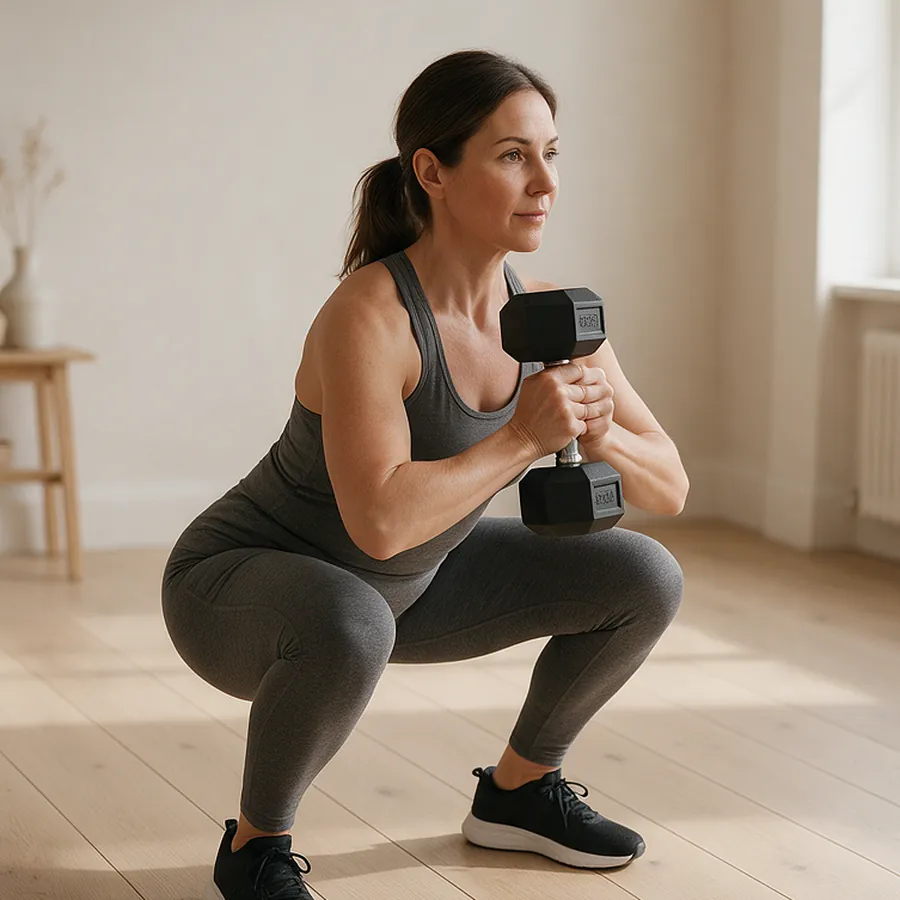
One pair of dumbbells, five moves, two rounds, ten minutes. This is the session on this site that does the most for the most people, because it touches every movement pattern a body uses: squat, hinge, pull, push and carry. It is written for someone who has never lifted and scales for someone who has. Every rep count and rest is below; the technique for each move follows, with the fault that most people make first.
The session
| Minute | Move | Reps | Notes |
|---|---|---|---|
| 0:00 to 1:30 | Warm-up: arm circles, 8 bodyweight squats, 8 hip hinges with hands on hips | Then the first set of goblet squats with the lighter dumbbell | |
| 1:30 to 5:00 | Round one: goblet squat, Romanian deadlift, bent-over row, shoulder press | 10 each | Move straight from one to the next; the change of exercise is the rest |
| 5:00 to 5:45 | Suitcase carry, 20 metres each hand, then rest | Walk the hall and back, swap hands | |
| 5:45 to 9:15 | Round two: the same four moves | 8 to 10 each | Same weight, or one notch heavier on the squat and deadlift |
| 9:15 to 10:00 | Finish: a walk around the room, one hamstring stretch each side, water | Done |
Weights to start. Most women who have not lifted start with 4 to 6 kg for the press and row and 6 to 10 kg for the squat and deadlift; most men 6 to 10 kg and 10 to 16 kg. The test is simple: the last two reps of each set should be hard and the form should not change. If you could do fifteen, the weight is light. If the ninth rep bends your back, it is heavy.
Frequency. Two or three times a week with a day between, which is the pattern in the trials the Westcott review covered, where ten weeks of resistance training added about 1.4 kg of lean weight in the adults studied. Alternate it with the kettlebell session or the bodyweight session if one pair of dumbbells gets dull.
The moves
1. Goblet squat
Hold one dumbbell vertically against your chest, both hands cupping the top end, elbows pointing down. Feet a little wider than hips, toes turned out slightly. Sit down between your heels, keeping the chest up and the dumbbell against the sternum, until the thighs are about parallel with the floor or as deep as the heels stay down. Stand by pushing the floor away.
The first fault: heels lifting and knees collapsing inward. Fix it by slowing the descent, pushing the knees out over the toes, and stopping at the depth where the heels stay flat; depth comes with weeks, not with force.
2. Romanian deadlift
Two dumbbells in front of the thighs, palms facing you, feet hip-width, knees soft and staying soft. Push the hips back as if closing a door behind you with your bottom; the dumbbells slide down the front of the legs, the back stays flat, the chest stays over the dumbbells. Stop when you feel the hamstrings load, usually around mid-shin, then drive the hips forward to stand.
The first fault: bending the knees into a squat. The knees stay where they started; the movement is at the hip. If you feel it in the lower back and not the hamstrings, the back has rounded; shorten the range.
3. Bent-over row
One dumbbell. Put the other hand and the same-side knee on a chair or bench, flat back, head in line with the spine. Let the dumbbell hang straight down, then pull it to the hip, elbow traveling back past the ribs, shoulder blade sliding toward the spine. Lower under control. All reps on one side, then the other.
The first fault: pulling the dumbbell to the shoulder with a flared elbow and a twist of the torso. The elbow stays close and the hips stay square to the floor.
4. Shoulder press
Standing, feet hip-width, a dumbbell in each hand at shoulder height, palms facing forward or slightly in, elbows a little in front of the body. Brace the trunk as if about to be nudged, then press both dumbbells overhead until the arms are straight, finishing with the dumbbells over the middle of the head, not in front of it. Lower to the shoulders.
The first fault: arching the lower back to get the dumbbells up. Squeeze the glutes, keep the ribs down; if the back still arches, the weight is too heavy for today.
5. Suitcase carry
One dumbbell in one hand, held at the side like a suitcase. Stand tall, shoulders level, and walk 20 metres, then swap hands. The whole job is not leaning toward the weight; the muscles on the opposite side of the trunk do the work.
The first fault: leaning away from the dumbbell to counterbalance. Use a lighter weight and imagine a glass of water balanced on each shoulder.
Making it harder over the weeks
- Weeks one and two: learn the moves at light weights; two rounds of 10.
- Weeks three and four: add one notch of weight to the squat and deadlift when all reps are clean.
- Weeks five and six: three rounds of 8 if the clock allows, or hold two rounds and go heavier.
- After six weeks: swap the shoulder press for the floor press one week in three, and the goblet squat for the step-back lunge, so the pattern stays and the stimulus changes.
Progression is the whole point: the body adapts to the weight it is given and stops adapting when the weight stops changing. Small, boring increases over months are what work in every trial.
What ten minutes of this does, and does not do
Ten minutes, two or three times a week, is enough to learn the five patterns, build the habit and add a meaningful amount of strength for someone starting from nothing; strength in the first weeks comes mostly from the nervous system learning the movement, which short sessions teach well. It is not enough on its own to produce the muscle and body-composition changes measured in the resistance training trials, which used two to three sessions a week of 30 to 60 minutes for ten weeks and longer. It is a start, a maintenance dose in a heavy week, and a complement to walking. It does not promise fat loss, a body shape or a number on the scale.
What the research says
- Westcott, Current Sports Medicine Reports, 2012, narrative review of resistance training in adults including middle-aged and older adults, 2 to 3 supervised sessions a week over 10 weeks and longer: ten weeks of resistance training increased lean weight by about 1.4 kg and resting metabolic rate by about 7 percent, and reduced fat weight by about 1.8 kg, with bone density improvements in longer programs. The contrary finding: a review of mixed studies rather than one trial, with effects that varied by age, program and starting fitness, and sessions far longer than ten minutes. doi.org/10.1249/JSR.0b013e31825dabb8
- Stamatakis and colleagues, Nature Medicine, 2022, prospective cohort of 25,241 UK Biobank adults with a mean age of 62 who reported no leisure-time exercise, wrist accelerometer measurement over a median 6.9 years: 3 to 4 short daily bouts of about one minute of vigorous everyday activity were associated with 38 to 40 percent lower all-cause mortality compared with none. The contrary finding: observational data cannot show cause, and the bouts were everyday activity such as fast walking rather than structured workouts. doi.org/10.1038/s41591-022-02100-x
- Bull and colleagues, British Journal of Sports Medicine, 2020, the World Health Organization 2020 guidelines on physical activity for adults: 150 to 300 minutes of moderate or 75 to 150 minutes of vigorous activity a week plus muscle-strengthening activity on 2 or more days, with the previous requirement that bouts last at least 10 minutes removed because the evidence showed activity of any length counts. The contrary finding: a guideline synthesises evidence rather than testing a ten-minute session, and the muscle-strengthening recommendation does not specify a session length. doi.org/10.1136/bjsports-2020-102955
Questions people ask
I only have one dumbbell. Do the goblet squat, Romanian deadlift (one dumbbell held in both hands), the row, a single-arm press and the carry. Everything here works with one.
Should I feel sore the next day? A little, in the thighs and the back of the legs, in the first two weeks. Sharp pain in a joint or the lower back during the session is a reason to stop and check the technique, not to push through.
Can I do this every day? Strength work wants a day between sessions for the same muscles. On the other days, walk, or do the stretch session.
I have a condition or an injury. Talk to a physiotherapist or doctor before starting; the moves can be adapted, and the adaptation is better chosen by someone who has seen you move.