
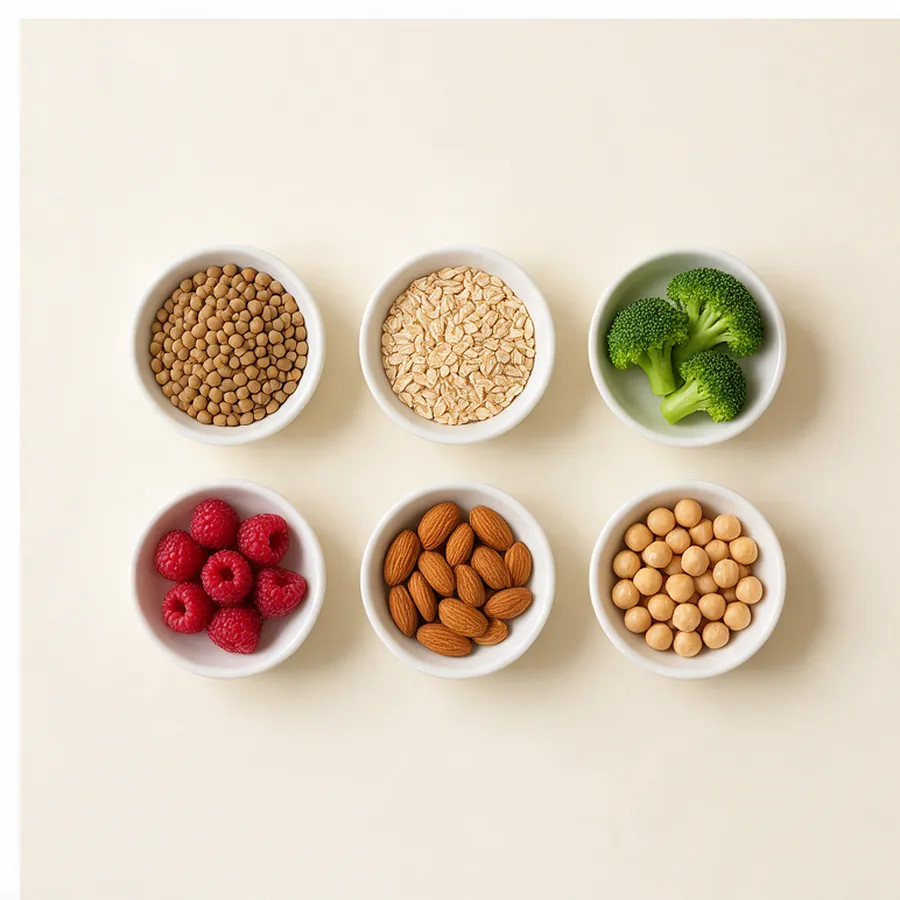
Adults need somewhere between 25 and 30 g of dietary fiber a day according to every major reference body, and most eat about half of that.
Those two facts explain most of what happens when people try to change: the gap is large, the foods that close it fastest are the ones that ferment most, and closing it in a week is the single most common reason the attempt hurts. This page sets out the numbers, what the different kinds of fiber do, and where each kind is on a plant-based plate.
The reference values
| Body | Figure | Note |
|---|---|---|
| EFSA | 25 g a day, adults | An adequate intake, set for normal bowel function; the same for women and men |
| US Dietary Guidelines | 14 g per 1,000 kcal | About 25 g for women aged 31 to 50 and 21 g over 50; 38 g for younger men; the Academy of Nutrition and Dietetics position paper uses these |
| UK NHS | 30 g a day, adults | The figure most British readers have seen |
| Lancet review, 2019 | 25 to 29 g a day | The band associated with the lowest risk across 185 prospective studies |
The US figure is tied to energy intake, which is why it is lower for older women and higher for young men; the EFSA and NHS figures are flat. For most adults the practical target is the same: somewhere in the high twenties, reached gradually, from food. The Academy of Nutrition and Dietetics position paper puts the average adult intake at about 17 g a day, so being short is the normal starting position, not a failing.
What the evidence is for
The reason the bodies agree is a 2019 series of systematic reviews in The Lancet covering 185 prospective studies and 58 trials. The highest fiber intakes, 25 to 29 g a day, were associated with 15 to 30 percent lower all-cause mortality and lower incidence of coronary heart disease, type 2 diabetes and colorectal cancer than the lowest, with a dose response, and the trials showed lower body weight and cholesterol at higher intakes. The contrary finding is the one this site repeats on every page: the mortality findings are observational, the trials mostly measured weight and blood lipids, and the data above 30 g a day were thinner. The target is a well-supported floor, not a competition.
The kinds of fiber, in practical terms
Soluble fiber dissolves in water and forms a gel. It slows digestion, which is why oats keep you full, and the beta-glucan in oats and barley lowers LDL cholesterol: in the Whitehead meta-analysis of 28 randomised trials, 3 g a day of oat beta-glucan (about 70 to 80 g of rolled oats) lowered LDL by 0.25 mmol/L over 2 to 12 weeks. Found in oats, barley, beans, lentils, apples, pears, citrus and chia.
Insoluble fiber does not dissolve; it adds bulk and speeds transit. Found in wheat bran, wholegrain bread, vegetable skins, nuts and seeds. It is the kind that helps with regularity and the kind that does least for gas.
Fermentable fiber is the part gut bacteria can eat, and it overlaps with soluble. Fermentation is the long-term benefit (short-chain fatty acids, a more diverse microbiome) and the short-term cost (gas). Beans, lentils, onions, garlic, wheat and some fruits also carry fermentable carbohydrates that are not fiber at all (oligosaccharides, fructans, sorbitol), which is why two foods with identical fiber on the label can feel completely different. The Academy position paper notes that inulin, for example, produces more gas than other fibers.
Most foods carry a mix. The point of knowing the difference is not to chase one kind; it is to understand why a bowl of beans and a bowl of oats with the same gram count land so differently, and to choose where to start.
Where the fiber is
Values are dietary fiber per serving from the USDA FoodData Central database, rounded to the nearest 0.5 g. The full searchable list is in the food finder.
Legumes
| Food | Serving | Fiber |
|---|---|---|
| Split peas, cooked | 1 cup, 196 g | 16 g |
| Lentils, cooked | 1 cup, 198 g | 15.5 g |
| Black beans, cooked | 1 cup, 172 g | 15 g |
| Chickpeas, cooked from dried | 1 cup, 164 g | 12.5 g |
| Kidney beans, cooked | 1 cup, 177 g | 11.5 g |
| Edamame, cooked | 1 cup, 155 g | 8 g |
| Chickpeas, canned, drained | half a can, 120 g | 7.5 g |
The densest category and the one most likely to cause gas at first. Half a cup is a sensible first portion; rinsing canned beans removes some of the oligosaccharides and most of the salt.
Whole grains
| Food | Serving | Fiber |
|---|---|---|
| Bulgur wheat, cooked | 1 cup, 182 g | 8 g |
| Wholewheat pasta, cooked | 1 cup, 140 g | 6.5 g |
| Pearl barley, cooked | 1 cup, 157 g | 6 g |
| Wholewheat cereal biscuits | 2, 47 g | 6 g |
| Quinoa, cooked | 1 cup, 185 g | 5 g |
| Rolled oats, dry | 40 g | 4 g |
| Brown rice, cooked | 1 cup, 202 g | 3.5 g |
| Wholegrain bread | 1 slice, 36 g | 2 g |
Swapping white for wholegrain versions of what you already eat adds 5 to 8 g a day per serving swapped; nothing new has to be learned.
Fruit
| Food | Serving | Fiber |
|---|---|---|
| Raspberries | 1 cup, 123 g | 8 g |
| Blackberries | 1 cup, 144 g | 7.5 g |
| Avocado | half, 100 g | 6.5 g |
| Pear, with skin | 1 medium | 5.5 g |
| Apple, with skin | 1 medium | 4.5 g |
| Prunes | 5 | 3.5 g |
| Orange, whole | 1 medium | 3 g |
| Orange juice | 1 glass | 0.5 g |
Whole over juice, skin on. Pears, apples and prunes also carry sorbitol, which some people find gassy and others find useful.
Vegetables
| Food | Serving | Fiber |
|---|---|---|
| Green peas, cooked | 1 cup, 160 g | 9 g |
| Broccoli, cooked | 1 cup, 156 g | 5 g |
| Spinach, cooked | 1 cup, 180 g | 4.5 g |
| Sweetcorn, cooked | 1 cup, 164 g | 4.5 g |
| Brussels sprouts, cooked | 1 cup, 156 g | 4 g |
| Potato, baked with skin | 1 medium | 4 g |
| Carrots, raw | 1 cup, 128 g | 3.5 g |
Lower per portion than legumes, higher than people expect, and the vegetables (peas, broccoli, sprouts) are the fermentable ones.
Nuts and seeds
| Food | Serving | Fiber |
|---|---|---|
| Chia seeds | 2 tablespoons, 28 g | 9.5 g |
| Ground flaxseed | 2 tablespoons, 14 g | 4 g |
| Almonds | 30 g | 3.5 g |
| Sunflower seeds | 30 g | 2.5 g |
| Pumpkin seeds | 30 g | 2 g |
| Walnuts | 30 g | 2 g |
Chia is the densest food on this page by weight and wants liquid with it; a tablespoon is a sensible start.
A day that reaches 28 g without a big bowl of beans
| Meal | Plate | Fiber |
|---|---|---|
| Breakfast | 40 g oats on soy milk, a cup of raspberries, a tablespoon of ground flax | 14 g |
| Lunch | Wholegrain sandwich (2 slices) with hummus and carrot sticks | 8 g |
| Dinner | Brown rice with half a cup of black beans and broccoli | 15 g |
| Total | 37 g |
That day lands above every reference value with one small legume portion, because the oats, berries, flax and wholegrain bread carry the rest. If 37 g is a long way from where you are, the gradual guide builds up to it over weeks, and the checker shows the starting point.
What the research says
- Reynolds and colleagues, The Lancet, 2019, a series of systematic reviews and meta-analyses of 185 prospective studies and 58 trials in adults worldwide, 25 to 29 g dietary fiber a day from whole foods compared with the lowest intakes, cohorts followed for years and trials of weeks to months: the highest intakes were associated with 15 to 30 percent lower all-cause mortality and lower incidence of coronary heart disease, type 2 diabetes and colorectal cancer, with a dose response; trials showed lower body weight and cholesterol. The contrary finding: the mortality findings are observational, the trials mostly measured weight and blood lipids, and data above 30 g a day were thinner. doi.org/10.1016/S0140-6736(18)31809-9
- Dahl and Stewart, Journal of the Academy of Nutrition and Dietetics, 2015, position paper for US adults, 14 g fiber per 1,000 kcal recommended (about 25 g for women and 38 g for men) against an average intake of about 17 g: most adults eat around half the recommended fiber, and higher intakes are linked to lower risk of several chronic conditions. The contrary finding: increasing fiber quickly causes gas and bloating; the paper advises gradual increases with fluids and notes that some fibers such as inulin produce more gas than others. doi.org/10.1016/j.jand.2015.09.003
- Whitehead and colleagues, The American Journal of Clinical Nutrition, 2014, meta-analysis of 28 randomised trials in adults, many with raised cholesterol, at least 3 g oat beta-glucan a day from oat foods and extracts over 2 to 12 weeks: LDL cholesterol fell by 0.25 mmol/L and total cholesterol by 0.30 mmol/L. The contrary finding: HDL and triglycerides did not change, and the effect was larger in people with higher starting values. doi.org/10.3945/ajcn.114.086108
Questions people ask
Do I need the same amount every day? No. The reference values are averages over time; a 20 g day and a 35 g day are an ordinary week.
Is more than 30 g better? The Lancet data above 30 g were thinner, and the comfort cost rises with the dose. Plenty of people eat 40 g comfortably; nobody needs to force it.
Do men really need 38 g? The US figure scales with energy, so a man eating 2,700 kcal lands at 38 g by the same rule that gives a woman 25. EFSA sets 25 g for everyone. Either way, the first job is the same: get from 17 to the mid-twenties without discomfort.
Does fiber from a supplement count? It counts toward the gram total; it does not bring the vitamins, minerals, protein and polyphenols that come with the food, and the Lancet findings were for fiber from whole foods.